
Tikitaka KYC verification searches need a source-first answer. The official terms checked for this guide were version 1.9, last updated 10 February 2026, and say Tikitaka can request information to manage an account, verify identity or verify source of funds. The listed examples include properly certified ID, proof of residence, proof of ownership and transaction histories of the payment methods used, including bank or card statements.
The same official KYC section says requested documents and information must be provided within 30 days after the request. It also says documents and information are usually verified within 10 days after the request is answered in full, with extra time or checks possible depending on the case. This is site-general verification context only: the terms also list the United Kingdom in Excluded Jurisdictions and say UK residents do not have the right to open accounts or add monetary funds.
KYC wording matters for trust analysis, but it is not a UK onboarding route.
The short answer
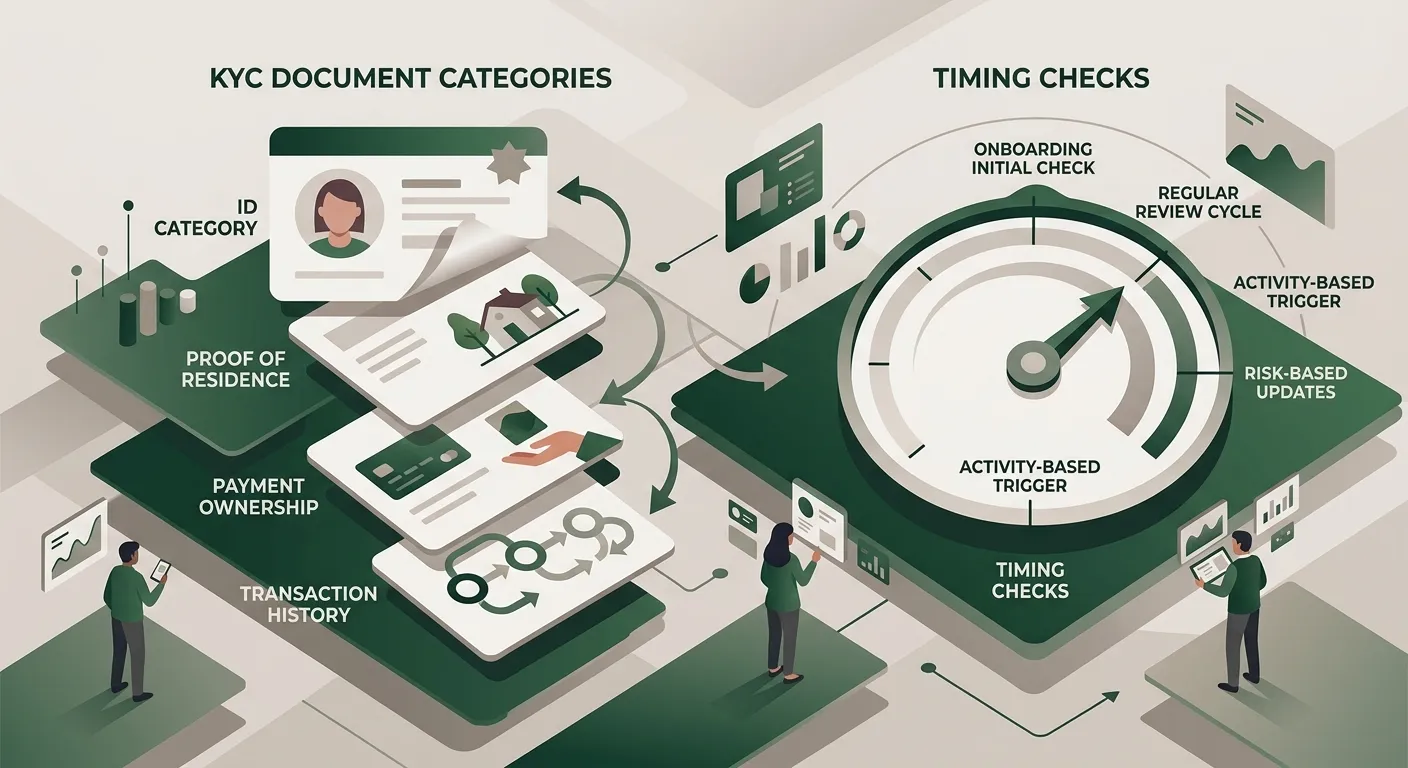
Tikitaka’s official terms describe KYC as a set of identity, age, residence, payment-ownership and source-of-funds checks. They can happen before or after deposits and before or during a withdrawal review. The document categories are not presented as a neat public upload checklist. They are examples of information the company can request when it manages an account, checks identity or reviews source of funds.
For a UK reader, the important boundary is that this page does not explain how to open or verify a Tikitaka account. The official terms evidence page explains why: United Kingdom residents are listed in Excluded Jurisdictions. The KYC details below help a reader evaluate source quality, withdrawal complaints and account-risk language without turning that evidence into account-use guidance.
Documents and information named in the terms
The terms name several categories. The first is properly certified ID, which is the identity-document category. The second is proof of residence. The third is proof of ownership of payment methods. The fourth is transaction histories for the payment methods used, with bank or credit/debit card statements given as examples. The terms also connect these checks to identity, age, residence, source of funds and other circumstances.
This wording is broader than a simple “send passport and utility bill” summary. It covers identity, address, payment ownership and payment history. That matters because a thin review can understate the scope of verification by listing only identity and address. A better source-check page keeps the whole set together and explains that payment-method ownership and transaction records can be part of the same verification process.
| Official term area | What the wording covers | How to read it from the UK |
|---|---|---|
| Identity | Properly certified ID and checks of identity and age. | Useful evidence of account controls, not a UK registration step. |
| Residence | Proof of residence and checks of residence or other circumstances. | Country status matters because the United Kingdom is excluded in the terms. |
| Payment ownership | Proof that the payment method used belongs to the account holder. | Relevant to withdrawal disputes and chargeback/refund context. |
| Transaction history | Transaction histories of payment methods, including bank or card statements. | Shows why source-of-funds and payout reviews can require more than ID alone. |
The 30-day and 10-day timing rules
The official KYC timing has two separate parts. First, requested documents and information must be provided within 30 days after the request is made. The terms also say the company can withhold payment or suspend the account until requested material is provided, and can permanently close the account if it is not provided in time. That makes the 30-day period a response deadline, not a promise that verification will finish inside 30 days.
Second, the terms say Tikitaka usually verifies documents and information within 10 days after the request is answered in full. The phrase “answered in full” is important because the clock described there follows a complete response, not a partial upload or an unanswered follow-up question. The same sentence also leaves room for extra time or checks depending on the circumstances and complexity of the case.
This is why KYC timing should not be quoted as a simple guaranteed payout clock. It is a verification-process statement. The separate Tikitaka withdrawal terms page explains how withdrawal request handling, payment-method choice, VIP or currency limits and compliance checks sit beside this KYC timing.
Why KYC matters for withdrawal complaints
KYC is one of the main reasons a withdrawal story can be hard to interpret from a short review. A public complaint might say a payout was delayed, but the missing facts could be whether identity checks were finished, whether proof of payment ownership was requested, whether source-of-funds material was pending or whether the response was complete. The official terms state that payments can be delayed while checks of identity, account balance, source of funds and compliance with the terms are performed.
That does not prove that a specific complaint is right or wrong. It gives a stronger reading method. A useful complaint record should show dates, request type, document status, support response and final outcome. The withdrawal complaints analysis page applies that method to public review surfaces, while this KYC page stays focused on the official document and timing wording.
The limits of this page
This page is not a verification how-to guide. It does not tell a UK resident how to create an account, submit documents, contact support for a live account action, bypass country controls or reduce verification checks. The reason is straightforward: the official country rule comes first. UK residents are excluded from opening accounts and adding monetary funds under the same terms that describe KYC.
It also does not turn Tikitaka’s site-general wording into local UK protection. KYC checks, a visible English interface or general account wording do not prove Gambling Commission licensing, GAMSTOP coverage or Great Britain consumer-protection routes. For that local context, use the account and age rules page and the UK-status cluster before reading any feature page.
Third-party checks and extra verification
The KYC section also says a recognised third-party provider can be used to undertake checks on the company’s behalf, including authorised credit reference agencies, identity verification services or fraud prevention software. It further says extra security checks can verify account information and activity, including checks by calls, phone, face verification or other verification required to confirm identity.
Those statements are useful because they show the verification section is not limited to static document upload. They also explain why a case can require additional checks after the first information request. A source that presents Tikitaka KYC as one fixed document list misses this wider wording. A stronger source keeps the document examples, the 30-day response deadline, the usual 10-day post-complete-response timing and the extra-check language together.
Separate the verification clock from the payout clock
A common mistake is to treat every timing phrase as if it describes the same clock. The 30-day wording is about the time allowed to provide requested information. The usual 10-day wording is about verification after the request has been answered in full. The withdrawal wording is separate again: financial-department handling can depend on other conditions and completed checks.
Keeping those clocks separate produces a better reader conclusion. A short review that says “KYC takes 10 days” drops the response deadline and the full-response condition. A review that says “withdrawals take three business days” drops the checks and conditions language. The more accurate approach is to read KYC timing, withdrawal handling and country restriction as connected but distinct terms.
Evidence hierarchy for KYC claims
The strongest KYC evidence is the current official terms page because it contains the document categories, response deadline and verification-timing wording in one place. The next useful evidence is a dated complaint or resolver record that states what was requested, when the player replied and whether the case was closed, resolved or still pending. A thin review snippet is weaker because it can repeat outdated or incomplete wording.
For UK readers, there is one extra filter: any KYC claim must be read after the United Kingdom exclusion. If a page explains Tikitaka verification as though a UK resident can proceed through normal onboarding, it is not preserving the controlling context. The KYC facts can still help evaluate trust and complaint quality, but they cannot be converted into UK account instructions.
Source freshness warning
KYC wording is high-risk information because document categories, response deadlines, verification timing and third-party checks can change. This page was written from a check of Tikitaka’s official terms version 1.9, last updated 10 February 2026. Any future update to the terms can change the exact document examples or timing wording.
For source checking, record the terms version, update date, KYC section and country-restriction section together. Recording only the document list is weaker because it can miss the United Kingdom exclusion. Recording only the country rule is also incomplete for trust analysis because KYC affects how withdrawals and complaints are evaluated.
KYC claim checklist
Use this checklist when reading Tikitaka KYC, withdrawal or account articles.
- Does the page state that the KYC details are site-general and not UK account guidance?
- Does it mention the official United Kingdom exclusion before any account-process language?
- Does it include ID, residence, payment ownership and transaction-history categories?
- Does it separate the 30-day response deadline from the usual 10-day post-complete-response verification timing?
- Does it acknowledge that additional time or checks can apply depending on the case?
- Does it avoid guaranteeing a payout date from KYC wording alone?
- Does it link KYC to withdrawals and complaints without assuming every complaint has the same cause?
Sources checked for this KYC page
The links below are verification sources only. They are not registration, deposit, withdrawal or real-money access instructions for UK residents.
Next checks
Use the account rules page for the wider registration and age-rule context, the non-UK withdrawal context page for payout terms, the payout review signals page for complaint interpretation, the United Kingdom exclusion page for the controlling terms evidence and the Tikitaka UK guide for the full evidence map.
Tikitaka KYC verification — More on this topic at tikitaka .
See also Tikitaka bonuses explained for UK readers .
Material created by the team Tikitaka