

Public review surfaces around Tikitaka include withdrawal complaints, pending-withdrawal stories and customer-support frustration. Those complaints are important signals, but they are not the same as verified findings for every account. A UK reader must also apply the official country restriction first: Tikitaka’s terms list the United Kingdom as an excluded jurisdiction and do not allow UK residents to open accounts or add monetary funds. This page therefore does not provide UK withdrawal steps or a payout route.
The aim is complaint literacy. Read the review date, the platform type, the company reply, the complaint status, the KYC position and the official withdrawal terms before deciding how much weight a claim deserves.
A withdrawal complaint is strongest as evidence when it is matched with dates, source type, status and official terms.
Complaint-signal snapshot
Withdrawal complaints usually combine three different things: a user allegation, a platform status and an official rule. Blending them together creates poor analysis. The table below separates them so a reader does not overstate a signal or dismiss it too quickly.
| Source element | What it tells you | What it does not prove by itself |
|---|---|---|
| Open review on Trustpilot | A public user says a withdrawal, balance, refund or support issue occurred. | It does not prove the account record, KYC status, bonus history or final outcome. |
| Company reply | The brand has responded publicly or directed the user to support. | It does not prove the issue was resolved unless the record shows that resolution. |
| Complaint-resolver page | A third-party complaint flow records a case summary, status, dates and sometimes resolver comments. | It does not automatically make every statement in the case a final finding. |
| Official withdrawal terms | The site-general rules for processing, pending withdrawals, checks and limits. | They are not UK withdrawal guidance because UK residents are officially excluded from funding. |
What Tikitaka’s official withdrawal terms say
The official terms describe site-general withdrawal handling, not a UK resident payout route. They say a customer can have a maximum of three pending withdrawals on the account. They also say withdrawal requests are worked through by the financial department within three business days after the request is made or within three business days after the last withdrawal request was paid out, provided the other conditions are met and checks are completed.
The same terms give Tikitaka room to delay processing for checks of identity, account balance, source of funds and compliance with the terms, and to postpone payments until verification procedures are completed. That wording is central when reading public complaints. A review saying “pending” could point to slow handling, an unresolved dispute, verification checks or missing context. The review signal is real as a warning topic, but the public post does not contain the full account file.
For a broader explanation of the site-general terms, use the withdrawal rules page. For the UK guardrail, use the United Kingdom exclusion page.
Why KYC changes the meaning of a complaint
Tikitaka’s KYC terms describe requests for identity documents, proof of residence, proof of ownership and transaction histories for payment methods, including bank or card statements. The terms say requested documents and information must be provided within 30 days after the request is made. They also say documents and information are usually verified within 10 days after the request is answered in full, while additional time or checks can be needed depending on the case.
That makes KYC status one of the first questions to ask when reading Tikitaka withdrawal complaints. Was verification requested before or after the withdrawal? Did the user say which documents were provided? Did the platform record a status? Did the company reply mention support escalation or missing information? A complaint without these details can still be useful, but it is a weaker source than a complaint page that records dates, resolver comments and a final status.
The KYC verification details page covers the document wording in more depth when it is time to read the account rules cluster.
Trustpilot withdrawal themes around Tikitaka
Trustpilot is useful for pattern detection. The current Tikitaka review surface mixes payment and withdrawal dissatisfaction, customer-service frustration and public company replies, alongside some positive reports of payouts arriving within roughly three to five business days. That spread tells a UK reader where to focus source checks: withdrawal timing, support clarity, KYC, limits and country restrictions. It does not turn each review into a verified finding.
A narrow checklist keeps the reading honest:
- Check whether the review is recent enough to describe the current terms and support behaviour.
- Look for specifics such as date requested, amount, method, KYC status and company reply.
- Separate withdrawal delay from balance dispute, refund dispute and blocked-account issues.
- Do not count repeated emotional wording as extra proof unless new facts are supplied.
- Do not dismiss recurring themes just because the platform is open to user reviews.
Casino Guru and AskGamblers complaint cases
Complaint-resolver pages add structure that open reviews lack. They can show whether a case was submitted, how long it had been pending, what the casino or resolver said, and whether it was closed, unresolved, rejected or resolved. Published Tikitaka cases illustrate the range: some are rejected when a player stops responding to verification questions, and at least one repeated-cancellation case was recorded as resolved only after the player made several attempts. That structure is why these sources feature in the Tikitaka trust review.
The limit is just as important. A resolver page still reflects a specific case. One closed complaint does not prove that every withdrawal is reliable, and one unresolved complaint does not prove that every withdrawal fails. The strongest reading is a pattern view: review themes plus resolver statuses plus official terms plus the UK restriction.
What makes a withdrawal complaint stronger evidence
A strong complaint source gives a timeline. It states when the withdrawal was requested, whether the account was verified, whether bonus funds or wagering rules were involved, what the payment status became and whether the company replied with a specific update. A weaker source gives only a conclusion. The conclusion can still be a warning signal, but it should not carry the same weight as a dated resolver record, because claimed delay and documented status guide very different reader conclusions.
A complaint is most useful when it preserves that context rather than only a verdict: the request date, verification status, payment method, number of pending requests, any company reply and any later update from the player. Open review pages show recurring themes across many users; resolver pages show a case path; forums show search intent and possible source risks. None of those sources replaces the official terms, and none changes the UK exclusion that controls this guide.
The UK filter: no withdrawal how-to
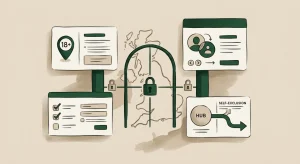
Because Tikitaka’s official terms exclude UK residents from account opening and adding monetary funds, this page does not convert withdrawal terms into UK instructions. It does not tell UK residents how to request, accelerate or route a Tikitaka payout. It explains how to assess public complaint signals for source quality and search-result literacy.
That matters because some UK-facing pages discuss deposits, withdrawals or bonus claims as if account use were available. The official terms and the no-verified-UKGC-local-licence result must be read before any payment claim. The payment methods context page handles funding restrictions, while this page stays focused on complaints and withdrawal review signals.
Complaint-evaluation checklist
Use this checklist before treating a Tikitaka withdrawal complaint as a strong trust signal.
- Identify the source type: open review, complaint resolver, forum post or editorial review.
- Record the date of the complaint and compare it with the terms version being discussed.
- Look for the stage: requested, pending, cancelled, approved, dispatched, received or disputed.
- Check whether KYC was requested, completed, rejected or still open.
- Check whether the user mentioned bonuses, wagering or account-rule issues.
- Check whether the company replied and whether that reply contained a case update or only a support request.
- Check whether a resolver page gave a final status or left the case open.
- Apply the UK exclusion before interpreting any account, funding or payout language for UK residents.
When a complaint claim is too strong
Some complaint pages and forum posts use absolute language. This guide avoids that approach. It does not state that every Tikitaka withdrawal fails. It does not state that all public complaints are proven. It does not treat a company reply as a complete defence. Each of those shortcuts loses information.
A better conclusion is narrower: public review surfaces contain withdrawal and support complaint themes, and official terms include withdrawal processing, pending-withdrawal, limit and KYC conditions that are relevant to interpreting those themes. For UK readers, the official United Kingdom exclusion and the no-verified-UKGC-local-licence result remain the primary controls.
Sources checked for this complaints page
The links below are verification sources only. They are not gambling access links and should not be used as UK account, deposit or withdrawal instructions.
- Official Tikitaka terms and conditions
- Trustpilot Tikitaka review page
- Casino Guru Tikitaka review page
- Casino Guru Tikitaka withdrawal complaint example
- AskGamblers Tikitaka review page
- AskGamblers Tikitaka complaints page
Next checks
Return to the main review hub for the full site map. Use the reputation framework for the wider trust method, the non-UK withdrawal context for payment-term details, the Tikitaka payments overview for funding restrictions and the official KYC wording page for verification timing.
Tikitaka withdrawal complaints — More on this topic at tikitaka .
See also Tikitaka official site, mirror domains and source checks .
Material created by the team Tikitaka